
TIFIN.AI exists to enable better wealth outcomes for more people.
Operating Desks for Wealth.
Composable agentic blocks for operations, investments, growth and business management. Deployed on the stack you already own. Licensed as software.
Deploy one component. Add more as they earn their place.
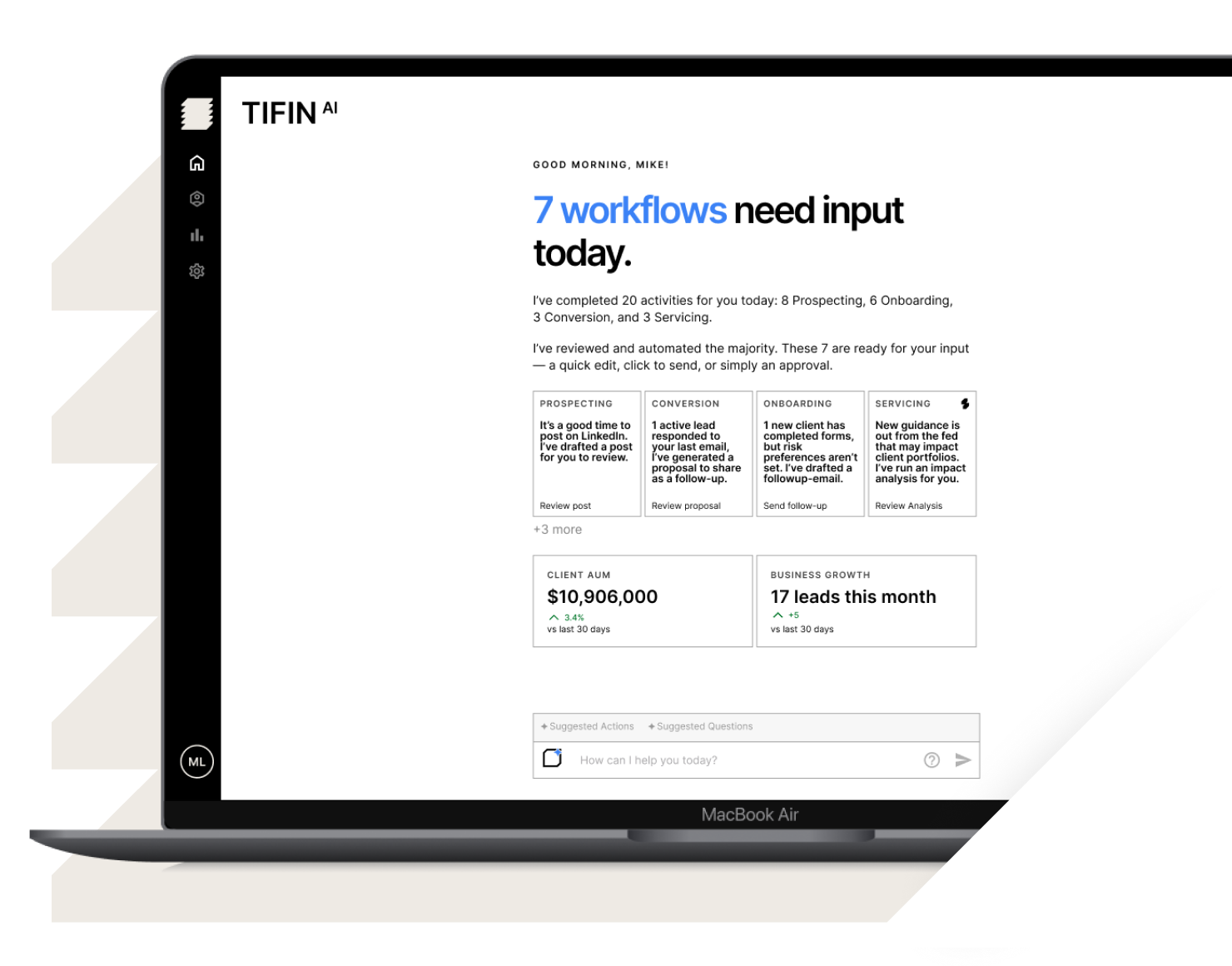
Capacity, function by function.
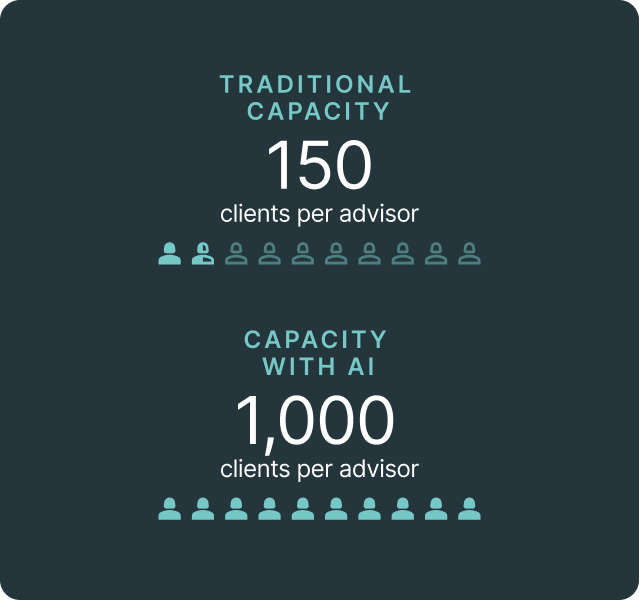
Client needs arrive faster than firms can serve them. TIFIN.AI changes the economics — and not only for advisors.
- Advisors — 5–7x more client relationships
- Operations — onboarding and servicing from weeks to under a day
- Investment teams — the house view delivered to every advisor
- Growth — coverage extended without added headcount
- Firm leadership — profitability and capacity modeled continuously
Segments that were never viable to serve become viable.
Platform architecture.
Some assume a powerful enough model will figure out context and coordination. It won’t. Models don’t know when a client just lost a parent or has a tax liability, nor what matters in each workflow. That requires system architecture.
The more functions you run agents across, the more that matters — context has to survive every handoff.


Human-System Experience
Proactive engagement across chat, documents, CRM, voice and mobile.
Agent Orchestration
Coordinates multi-agent, multi-desk workflows — native and third-party.
Agent Library
The components themselves, and what makes each one reliable.
Context Layer
Unifies data, tools and business rules so agents act on goals.
Enterprise-Grade Assembly
Privacy, compliance, observability, explainability.
COMPONENTS
Component library.
Specialized agents, organized by the functions wealth firms run. Each one deploys on its own. Each one shares context with the next.
- Operations — account opening, KYC/AML, ACATS transitions, firm onboarding, CRM maintenance, document intelligence, meeting preparation
- Investments — model delivery, drift detection, research and selection, performance reporting, private markets, annuities
- Growth — client knowledge, exposure analysis, distribution, marketing
- Business management — practice P&L, advisor productivity, client profitability, capacity planning, forecasting
INFRASTRUCTURE
The Harness
Every agent runs on common infrastructure designed to improve reliability and reduce the cost of adding each new component.
Nothing in it is rebuilt per agent — which is why the tenth component costs less to run than the first.
- Procedural memory — agents learn how your firm works, not just what happened
- Cost controls — context planning and model routing keep usage from becoming spend
- Multi-modal — card, document, CRM task, chat, voice, mobile
- Guardrails — wealth-specific schemas constrain what an agent can produce
- Permissions and ethical walls that travel with the work
- Evaluation before release. Observability and audit trails after.
ORCHESTRATION
Coordination
Agents are easy. Handoffs are hard.
A single agent can draft an email. Real work in wealth crosses roles as often as it crosses systems.
Onboarding a firm runs components across four constituencies — advisor support, the advisor, the business and the client. Each passes context to the next. Permissions and audit trails travel with it.
Same components for every user, configured to your rules.
Onboarding, account opening, transitions, monitoring and servicing.
Portfolio management, model delivery, research and reporting.
Marketing and distribution execution.
Practice P&L, productivity, profitability, capacity and forecasting.
IN PRACTICE
A $10B+ RIA aggregator faced a bottleneck.
Onboarding new firms took 10-12 weeks of heavy operations work.
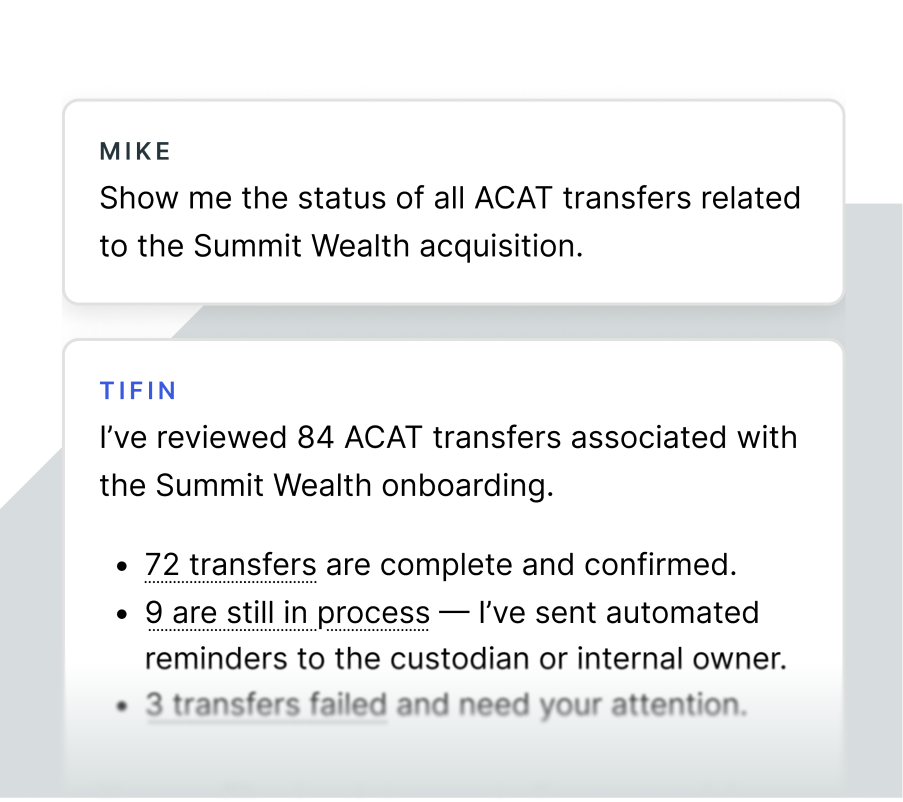
TIFIN.AI deployed onboarding and servicing agents to execute operational workflows including ACAT transfers, advisor support, and model monitoring.
- Onboarding reduced from weeks to <1 day of human input
- Operations teams reduced manual processes
- Advisors receive automated client materials and meeting preparation
The aggregator now supports more RIAs with a smaller operations team.
Switch on one component. Measure it.
Questions?
AI for financial advisors refers to systems that use AI agents to automate and execute advisory, operational, and investment workflows. These agents handle tasks such as client onboarding, portfolio monitoring, meeting preparation, compliance checks, and account servicing. In wealth management, agents are orchestrated across workflows using shared data and context, allowing firms to scale service and deliver insights more efficiently.
AI agents help financial advisors serve more clients by automating many of the operational and analytical tasks that normally require manual effort. Specialized agents can handle workflows such as client onboarding, portfolio monitoring, meeting preparation, compliance checks, and account servicing. By reducing time spent on administrative work and coordinating these processes in the background, AI agents allow advisors to focus on client relationships and strategic guidance—enabling teams to scale their capacity while still delivering personalized advice.
An agentic AI platform for wealth management is a system that orchestrates multiple AI agents across advisory, operational, and investment workflows. Instead of standalone tools or chat interfaces, the platform coordinates agents using shared context, rules, and data infrastructure. This enables agents to execute tasks in sequence, integrate with enterprise systems, and operate within compliance requirements — with firms deploying the components they need, function by function, rather than adopting one all-or-nothing system.
AI improves operations for RIAs and wealth management firms by using AI agents to automate and orchestrate workflows such as onboarding, account transfers, reporting, and client servicing. Agents reduce processing time, standardize execution, and surface exceptions for human review. This allows operations teams to support more advisors and accounts while maintaining control and oversight.
AI enables financial advisors to deliver personalized advice by using orchestrated agents to analyze client data and portfolio holdings at scale. These agents generate tailored insights, prepare client materials, and monitor portfolios continuously. Advisors remain focused on relationships and decision-making while agents handle the underlying workflows, allowing personalized guidance to extend across a larger client base.
Software. Sometimes headless. TIFIN.AI is a licensed platform of agent components that deploy into your existing environment and are configured to your data, rules and policies. Every customer runs the same components and receives the same releases. Implementation support comes with deployment — but the product is the software, not an engagement.
No. TIFIN.AI runs on top of the systems you already own — CRM, custodial platforms, portfolio accounting, research and market data. Agents connect through APIs and operate across those systems rather than replacing them. Your systems of record stay where they are.
Yes, and most firms do. Deployments start with the function where the bottleneck is clearest — onboarding, account transitions or meeting preparation — and expand from there. Because components share a context layer, each one added makes the others more effective.